One of the things I am still learning, two months into working independently, is that I do not think best in straight lines.
I should probably have known this sooner.
I had already spent years seeing versions of the same pattern in schools. In students trying to build learning habits. In coaching conversations with people I line-managed when they had got stuck in a problem they were slightly afraid to tackle alone. In those moments when someone did not need a perfect answer from me but did need help getting moving again.
A middle leader would appear in my office doorway, hover for a second, then say something like, “Can we think this through together?”
They would outline the problem. I would usually stop them after a minute or two and ask three things first: what slant they wanted us to think in, what the biggest issue was as they saw it, and what they were trying to get to in the longer term.
Then I would give my standard disclaimer. These were just first thoughts. None of the ideas needed to stick. We were not looking for the answer. We were trying to generate some possibilities.
Then we would brain dump.
Ideas, connections, tensions, options, half-formed thoughts. Two minutes of throwing things into the space. Some useful. Some not. Some worth dropping immediately. Then they would join in. They would question me, push back, add context. I would refine, adjust, reorder. Between us, something would start to take shape. Not a perfect answer, but usually a few stronger options than either of us had when they first walked in.
I called this popcorn thinking.
It is useful. Often very useful.
People came to me for exactly that reason when they wanted a way through complexity, a fresh angle on a problem, or help getting something unstuck. They knew I could make connections quickly and move things forward when things were a bit foggy.
But popcorn thinking has a downside.
It is messy. It does not arrive with a built-in hierarchy. A throwaway thought can sound as weighty as the real point if I have not yet sorted it. The sparks are not the structure, but they can easily be mistaken for it.

That is the part I have been seeing more clearly in my own work now. My first stage of thinking is associative, spatial and slightly unruly. That is not the problem. The problem comes when I try to force that stage straight into a format designed for polished reporting rather than active thinking.
Official documents and proformas can become my dementors.
They flatten my energy almost immediately. I get bogged down in them. I lose the thread. I start resisting the work itself, not because I do not understand it, but because the format asks me to sequence and formalise too early. By the time I have wrestled the thinking into rows, boxes and worthy-sounding sentences, I often don’t want to finish it. I am certainly not inspired to talk someone else through it.
Working on slides helps me do something different. Not because I think in slides. I do not.
But a blank slide makes me decide. What is the point here? What deserves the most space? What is supporting detail? What can be ditched? What belongs together? What needs to come later?
Slides force hierarchy. They make weight visible.
They also give my mind room to circle back, move things around, test a sequence, change it again and gradually build a story. A Word document will let me keep everything. It is too forgiving. It allows accumulation to masquerade as clarity.
Over the last few months, I kept producing deliverables in Word because that was the expected format. It looked more official. More properly professional. But I was slower, flatter, and less confident in my own thinking than I had been in years.
So for my first major deliverable, I stopped pretending.
I did the research, the note-taking and the pattern spotting first. Then I built the thinking in slides. I moved ideas around. I grouped them. I cut them. I worked out what was central and what was just popcorn. Only after that did I think about the formal output.
It was faster. Clearer. Better.
And my uncomfortable realisation is that none of this was entirely new.
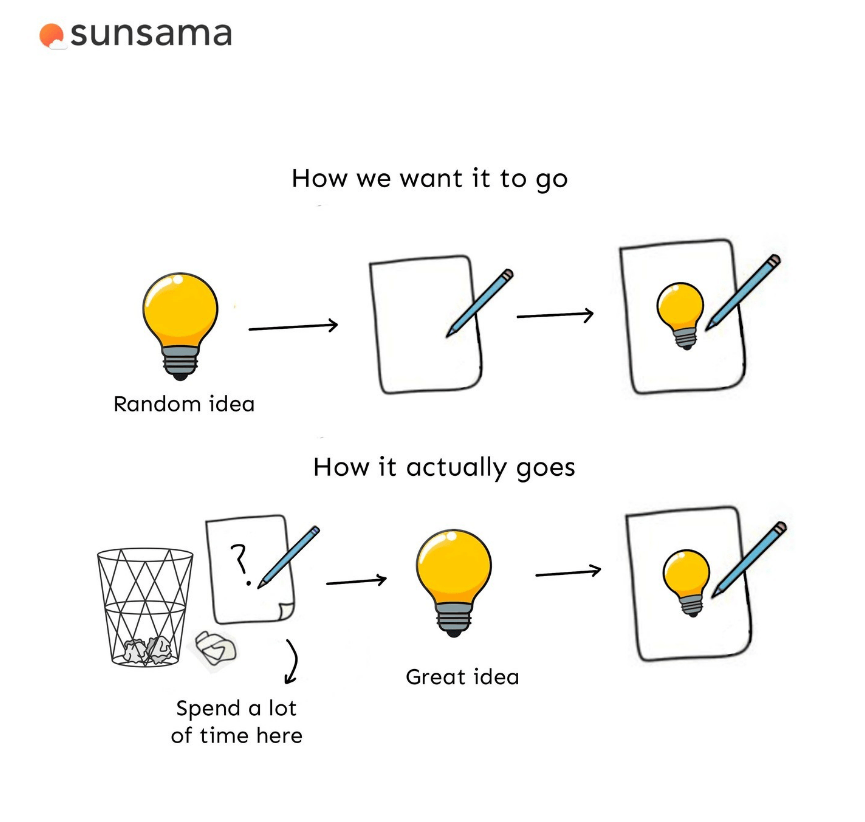
For years, I watched high-achieving students mistake the messy middle for a personal failing. They felt anxious when they could not get straight to the answer, as if the iterations in between meant they were struggling more than everyone else. Often, they just could not see the hidden steps. The drafts. The false starts. The reordering. The thinking again.
I knew that.
I also knew, in a different way, that the same was true in coaching and mentoring. The people who came to me when they felt stuck were not incapable. More often, they were overwhelmed by the foggy middle of a problem. They needed someone to help them name what mattered, reduce the noise and get enough movement to stop fear hardening into avoidance.
I knew that too.
The irony is that I was doing the exact same thing in my work.
I was feeling friction, flatness, and resistance, and reading them as a problem with me rather than asking whether I was trying to think in a format that cuts across how my mind actually works.
That was a humbling moment, realising that a pattern you could clearly see in students and colleagues has been shaping your own behaviour too.
Learned patterns run deep.
We hide so much between the first spark and the final outcome. We present finished thinking as if it arrived cleanly. We smooth over the dead ends, the conversations, the reshaping, the fourth pass that made the whole thing finally make sense. The final version looks direct. It rarely was.
I am starting to think this invisibility does more harm than we admit.
Maybe part of showing our work is not only about openness. Maybe it is about making the hidden stages of thinking visible enough that people stop mistaking them for inadequacy.
And maybe one of the things I am still learning, as I build this next chapter of work, is to extend to myself the same patience with process that I so readily offer to others.
 Gemma Archer
Leave a comment